Field Trip

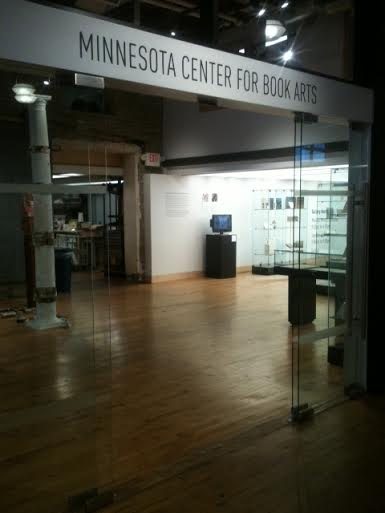
MCBA EntranceRecently I made a trip down to the Twin Cities, where I had the chance to visit the Minneapolis Center for Book Arts in Minneapolis. Heidi recommended that I make the trip back when I met with her, and I’m so glad that I went! The exhibit I saw was called”The Contained Narrative: Defining the Contemporary Artist’s Book.” Although not directly applicable to my current research, the exhibit gave me a lot to consider about the significance of the book as art versus as a way of conveying literature.

One panel that especially made me think was entitled “The Book as Object,” which asserted that “A book may be altered with the artist repurposing the original form and content to create a new narrative.” Along with the various art pieces made of deconstructed books (see an example below), this reminded me of something Dr. Sprunger mentioned at one point. He told me that many old, important books (like the Urry Chaucer) are taken apart so that each individual page can be sold, because a seller can make more money if they sell the pages individually rather than as a combined whole.
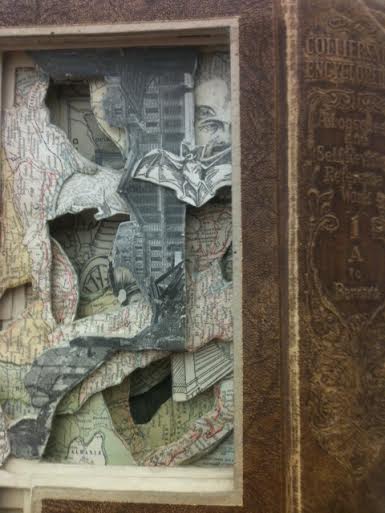
A Looseleaf and Self Revising Reference Work Brian Dettmer - 2010
A Looseleaf and Self Revising Reference Work
Brian Dettmer – 2010

The exhibit forced me to consider where the value is in a book. Is the Urry Chaucer important because of its text, or because of the literal value in each individual page? Or is it important as a whole – important due to some combination of the physical object and the words that compose it? This is the interpretation with which, after much thought, I’ve decided I most agree. There is a special value in the solid objectness of a book when combined with the much more subjective messages it contains.
Text Comparison Programs

Now that I have access to 4 different editions of Troilus and Criseyde, I’ve been working to find a computer program that allows me to easily identify and compare differences in punctuation between versions of the text. I’ve tried 4 programs so far; the first, Voyant, I reviewed in an earlier post, which you can read here. Since then, I’ve tried WinMerge, ExamDiff, and the Compare feature on Microsoft Word. In each program, I copy/pasted verses 77-104 of Book Two and verses 248-268 of Book Five, which I  transcribed for this purpose. I have been using the Speght and Urry transcriptions of the text for each comparison so far.

WinMerge

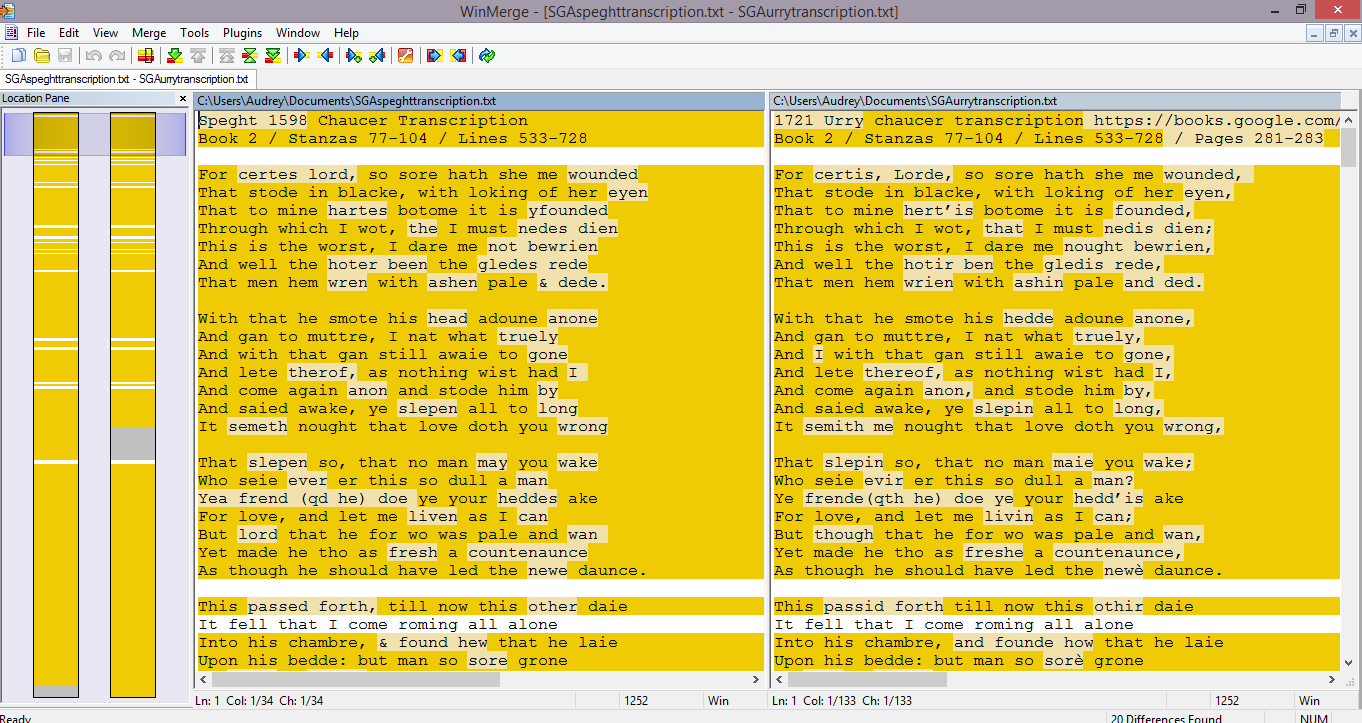
Although WinMerge certainly has its uses (it seems to primarily be created for coders who need to find tiny differences in code), it was confusing for me to use and felt unsophisticated. WinMerge, as shown below, merely highlights every word that isn’t identical between two versions of the text. Since my texts have many small differences, especially in spelling, this resulted in nearly the whole text being highlighted.

Screenshot (3)
Click on any of the images to view a larger version.

ExamDiff

ExamDiff was similar to WinMerge, but even less suitable for this particular project. As shown below, ExamDiff highlights the entire line of text whenever the two versions are not identical.

ExamDiff

Microsoft Word

I hadn’t used the Compare feature on Word before, but after disappointing results with the first three programs, Dr. Sprunger (my mentor for this project) recommended that I give it a try. I have found this to be the easiest to use and most helpful program by far, and I plan to use Compare for the rest of this portion of the research.

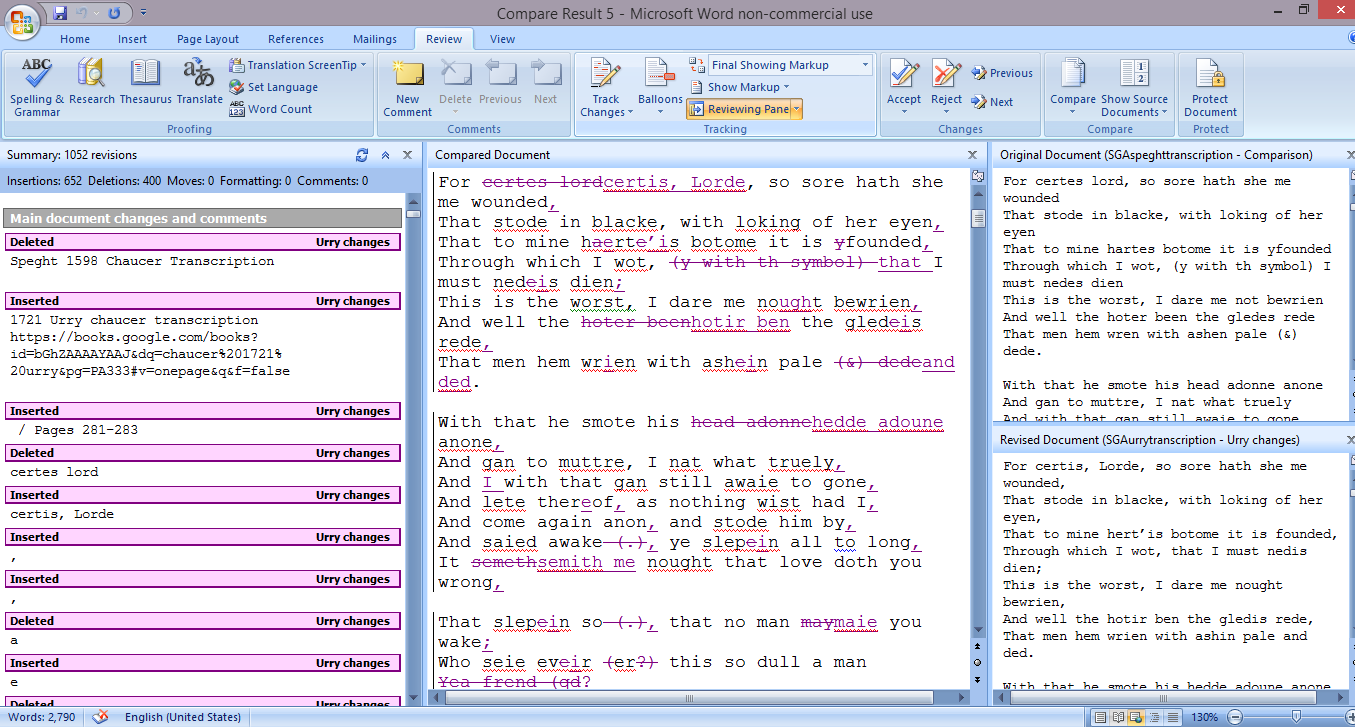
Compare provides a great deal of information all at once, including a list of insertions and deletions, a combined version of the two texts with each change marked, and the original texts, all displayed side-by-side. It looks like this:

Word

Though I was disappointed by the free comparison software available online, Microsoft Word has proven itself reliable and user-friendly, as well as able to provide a the best analysis tools for this research.

Meeting with Lisa

After meeting with Heidi (which I wrote about in my last two blogs), I had the chance to meet with Lisa Sjoberg, the fantastic college archivist. She taught me about safely handling old, rare texts (like the Urry Chaucer), and also got me started exploring the ways in which Digital Humanities resources may be helpful during this research.

Handling Old Texts

Lisa started by talking about how to handle the Urry volume without damaging it. She told me that many libraries and archives no longer recommend using gloves when dealing with these texts, as the oils in our hands often cause less damage than gloves, which can hinder the turning of pages and lead to tears.

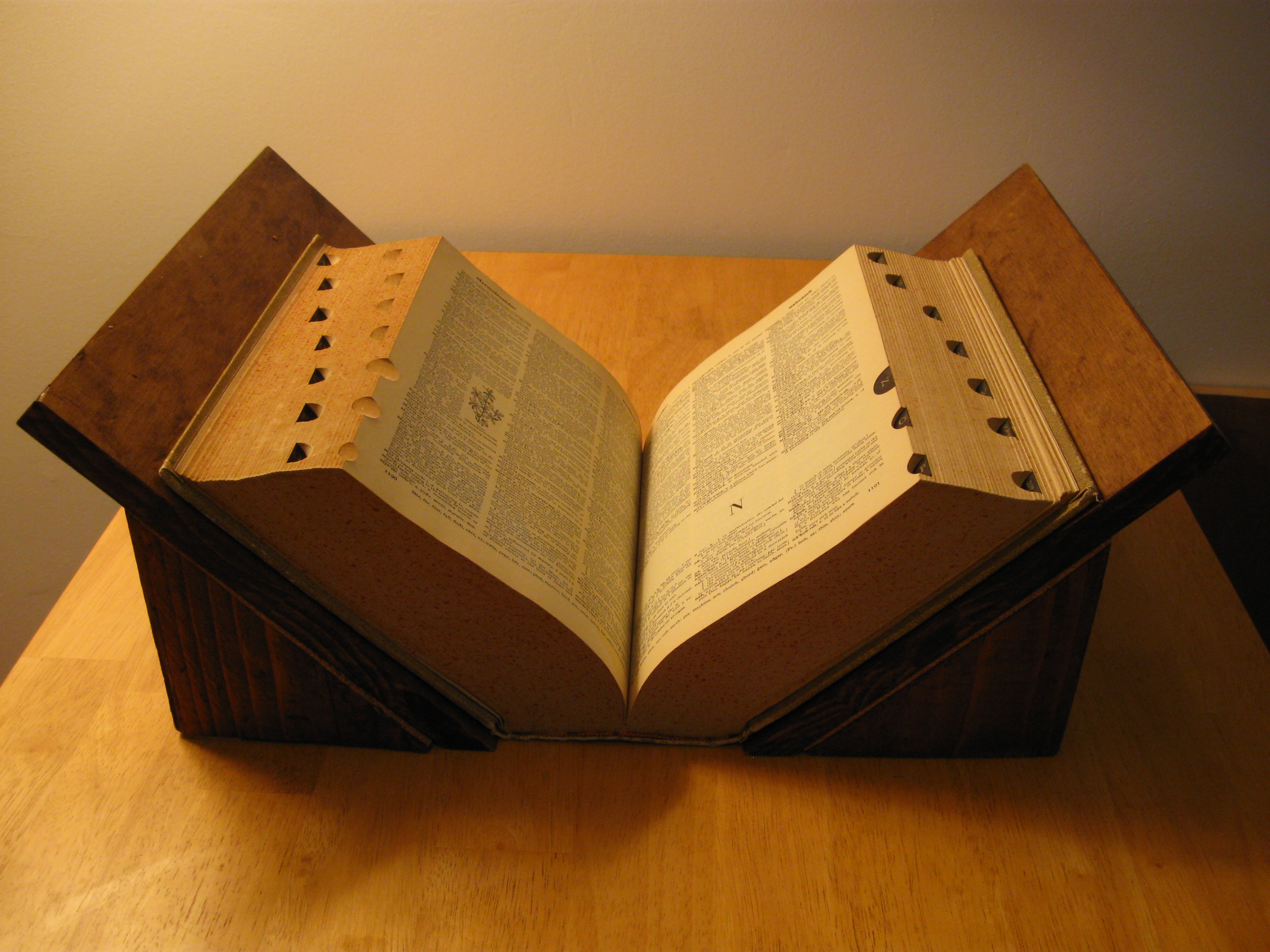
She also told me that a book stand would protect the spine of the Urry volume, although we unfortunately don’t have one available to use. Book stands, often used for heavy dictionaries (as pictured below), keep the book from laying flat. Opening a book flat against a table can cause damage to the spine.

Here's an example of an angled book stand
Here’s an example of an angled book stand

Lisa also discussed the importance of protecting the book from less obvious damage; for example, I should always wash my hands before handling the book, in order to protect it from oils and other materials that build up on skin. Furthermore, the book should be kept in an acid-free box when it isn’t being examined in order to protect it from damage caused by the sun and environment.

Digital Humanities

In addition to teaching me how to handle old, important books, Lisa introduced me to the field of Digital Humanities, and talked about how DH tools may be helpful for my research. As she explained during our meeting, Digital Humanities is an up-and-coming field which examines the ways in which technologies of our digital age can be used to study the humanities.

For my research, I need a program that allows me to compare punctuation between several editions of Troilus, noting the differences between each edition so that I then can examine how each difference changes the meaning of the text.

Lisa recommended that I try Voyant, which is a text-analysis tool created for use in the digital humanities. Voyant has several interesting features with which I have since experimented (for example, it provides the frequencies of different words within a text, and will create a word cloud, similar to Wordle), but is perhaps not the best tool with which to examine punctuation specifically. In a later blog, I will cover some of the other computer programs I have tried out during this process.

Thank you so much to Lisa for taking the time to help with my research!

Meeting with Heidi – Part 2

In Part 1 of this post, I covered what I learned from art professor Heidi Goldberg about bookbinding. In this post, I’ll discuss what she taught me about printmaking.

Modern printing is mostly done by machines, but there are still people who know a great deal about traditional printmaking, and Heidi is one of them. The text I printed with her was much shorter than a Chaucerian tome, but otherwise the process we used is fairly similar to the one used by the printers of the Urry edition.

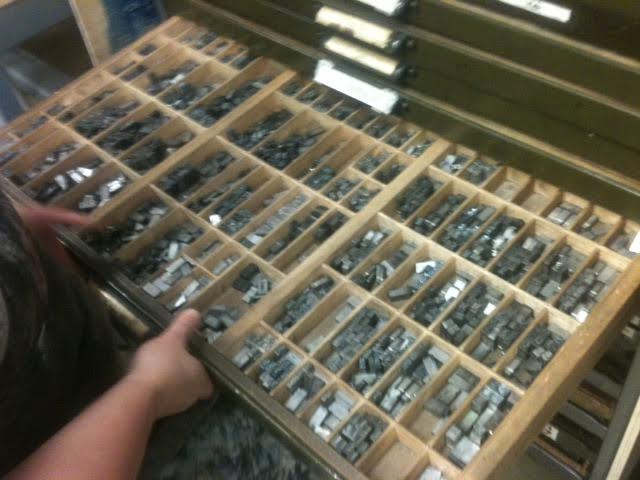
We began by choosing a font – each available font has its letters and symbols laid out in a case like this:

typeInterestingly, the uppercase letters (on the right side of the case) are mostly kept in alphabetical order, with two exceptions: the newest letters to our alphabet, J and U, are placed after Z.

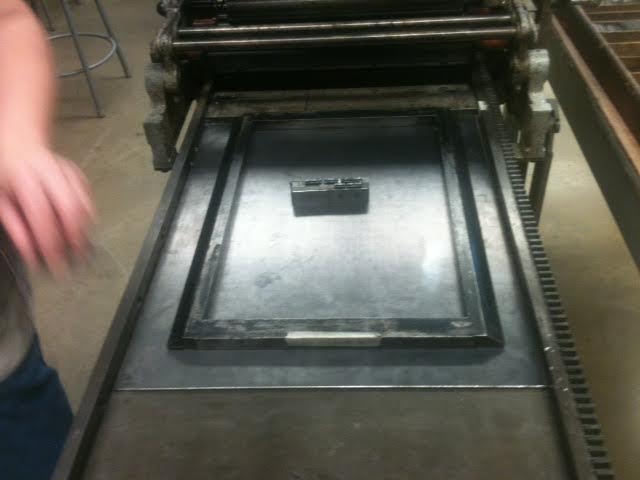
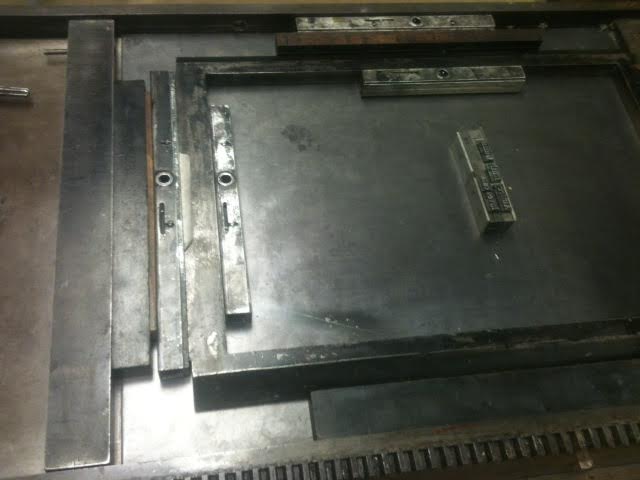
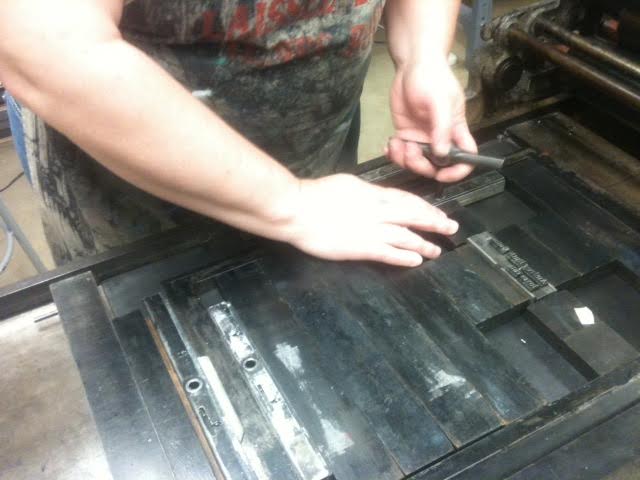
After we assembled our text, we placed it on the printing press and set a frame around it. We then used metal and wood blocks to hold the text in place within the frame:

Our text is in the middle, and we've set a frame around it
Our text is in the middle, and we’ve set a frame around it
Our type is in the middle, and we're building around the frame
Now we’re building around the frame to hold the text in place during printing
There we go! The text can't move now when we print
There we go! Now the text won’t move.

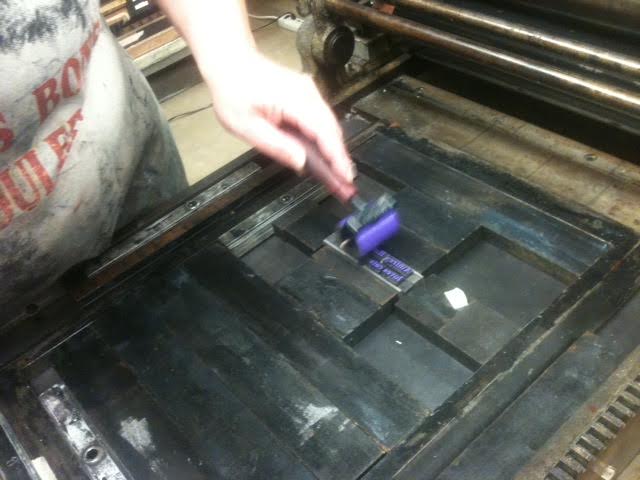
Next, I chose my favorite color, and we painted ink onto the type. (Okay, Urry’s printers didn’t use purple, but I did!)

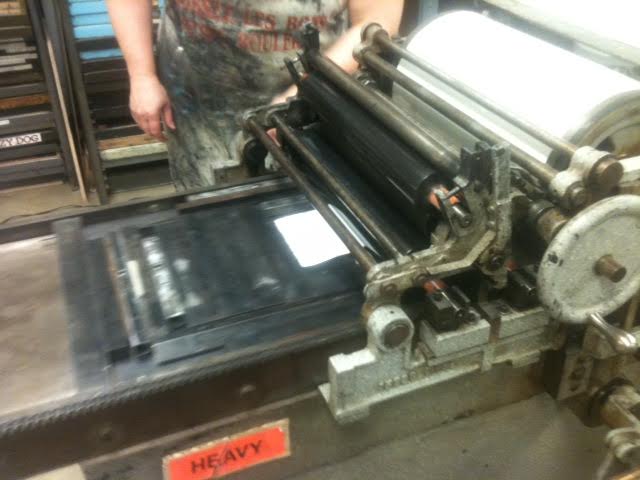
painting typeFinally, we added a sheet of paper, and ran it through the press to print!

Printing...
Printing…
f
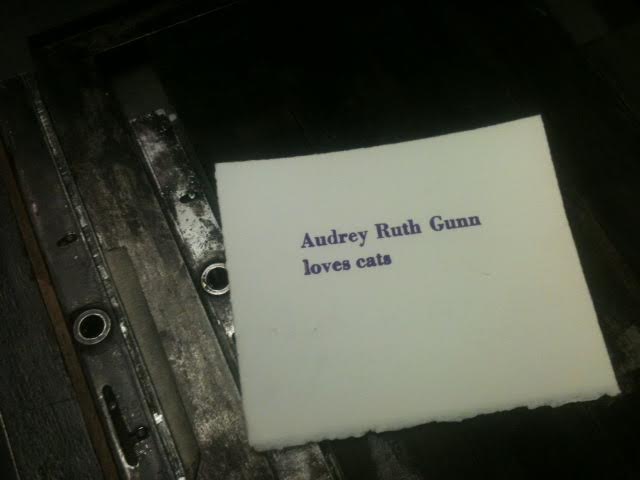
And here’s the final product!

Thank you again to the wonderful Heidi Goldberg for teaching me so much about bookbinding and printmaking. I have a much better understanding now of this long and complicated process – no wonder books were still so expensive in Urry’s time!

Meeting with Heidi – Part 1

I’ve now had the opportunity to meet twice with Heidi Goldberg, an art professor at the college. During these sessions, Heidi taught me a great deal about bookbinding, printmaking, and the making of the Urry edition specifically. In Part 1, I’ll discuss what I learned about bookbinding, and I’ll cover printmaking in Part 2.

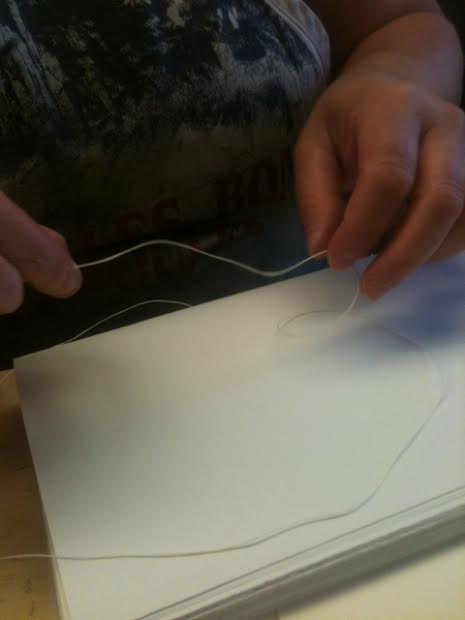
Heidi started by teaching me about some of the materials used in the Urry volume. After examining the book, she said that it was bound with linen thread, which is extremely strong; she gave me a piece of the thread and told me to try to pull it apart, and I couldn’t do it!

Here's an example of linen thread
Here’s an example of linen thread
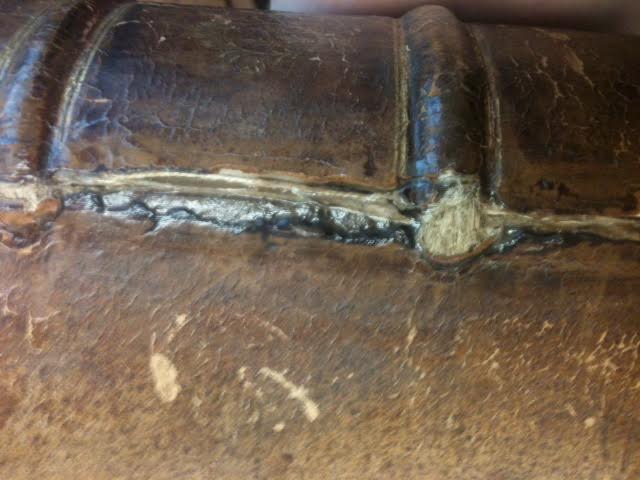
This strong thread has helped to keep the Urry edition in one piece for a long time, but it's frayed quite a bit
This strong linen thread has helped to keep the Urry edition in one piece for a long time, but it’s frayed quite a bit

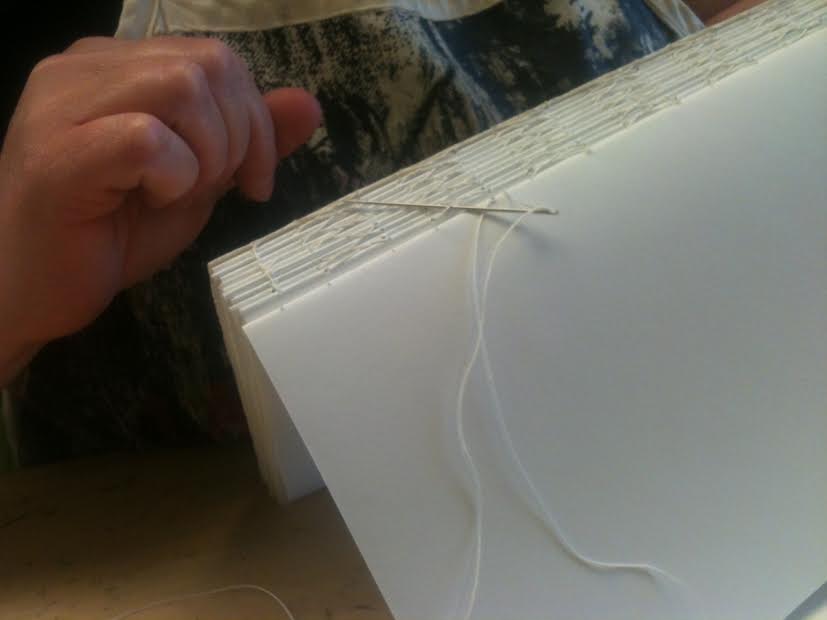
She also showed me how to use the linen thread to sew together each set of printed pages (called a “signature”) with the next. Her method probably isn’t the same as that of Urry’s printer, but it’s interesting nonetheless:

Heidi sews together signatures in her own book
Heidi sews together signatures in her book
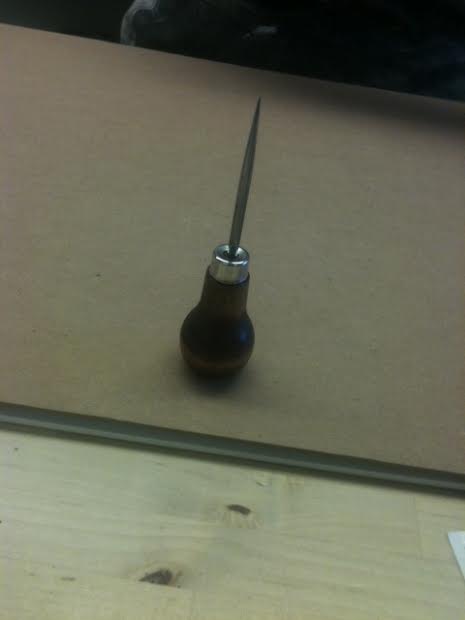
She uses an awl to pre-punch holes in each signature, allowing the needle to go through the paper more easily

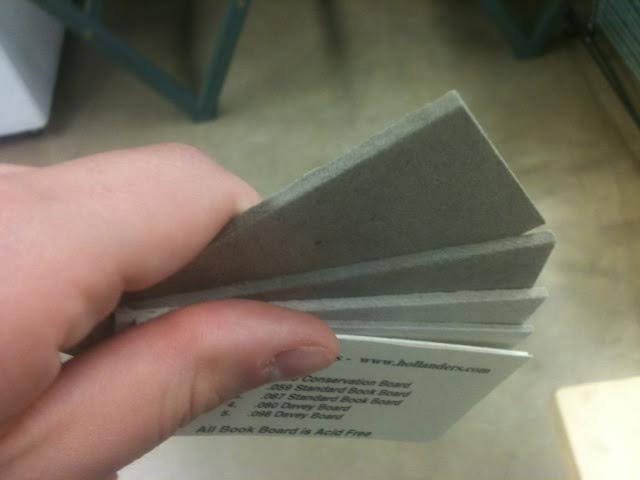
Another important material when making a book is the book board, which is one of the most common materials for a book’s cover. This sampler shows many different options that one can purchase, but Heidi estimates that the book board cover of the Urry edition is twice as thick as the book board here!

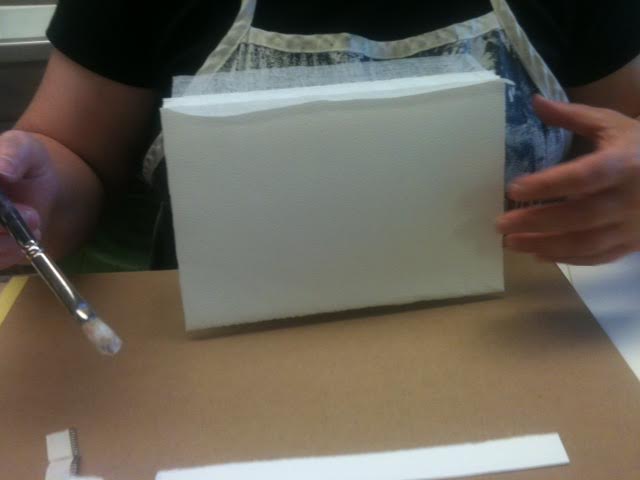
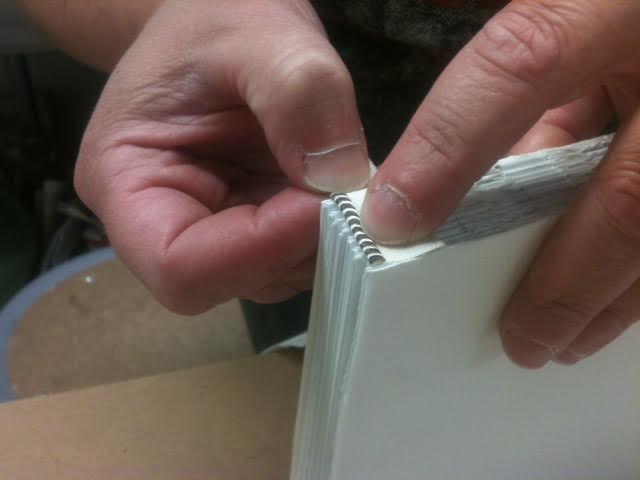
book boardAfter sewing together the signatures, the next step in binding a book is to cover the spine in glue. Bookmakers use a special type of glue, called PVA, which allows for greater flexibility when dry than normal glue. Heidi has added mull, which looks similar to cheesecloth, to the binding here, providing the PVA with a place to settle. In the second picture, she’s added headband, which helps to strengthen the ends of her book.

Heidi paints glue on the spine
Heidi paints glue on the spine over the mull
Headband is added to the ends of the spine

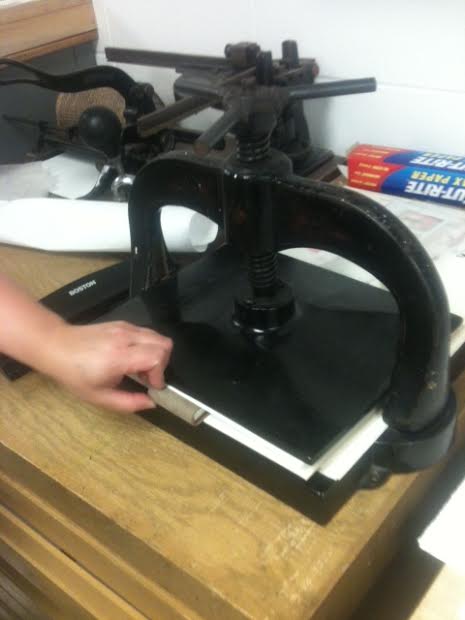
Finally, Heidi used a finished book to show me how a nipping press (pictured below) can be used. After a book has been glued, she’ll often put it in the nipping press to make sure it dries flat. The weight of the press keeps a drying book in place.

Nipping press
Nipping Press

If you’d like to see professionals in action, here’s a great video that shows the process of bookbinding. In my next post, I’ll cover Part 2 of my meetings with Heidi – printmaking!

The Testament of Cresseid

My next step in this research was to read The Testament of Cresseid, written by Robert Henryson in the late 15th century. This poem is essentially 500-year-old fanfiction, imagining an untimely death for Criseyde in which she is struck with leprosy by the gods after blaming them for her rejections at the hands of Troilus and Diomedes.

Like many other “Chaucerian” works of dubious origin, the Testament was often published along with Chaucer’s own Troilus and Criseyde in early editions of Chaucer’s works, including the 1721 Urry edition.

The Testament as it appears in Urry's edition
The beginning of the Testament as it appears in the Urry text

The introduction to the Testament in the Urry Chaucer (pictured above) demonstrates that scholars were aware that this was not Chaucer’s own writing; many other spurious works (such as The Plowman’s Tale) were published repeatedly under Chaucer’s name.

Secondary Sources

1. Editing Chaucer: The Great Tradition, edited by Paul G. Ruggiers

This book has chapters covering each of the major Chaucer editors, analyzing their editorial practices and editions of Chaucer’s texts. The chapters which cover Chaucer editors preceding Urry (Caxton, Thynne, Stow, and Speght) were helpful in allowing me to learn the editing precedents set by the time Urry’s volume was published. For example, Speght’s 1598 and 1602 editions, the last major editions of Chaucer until Urry’s 1721 publication, were relied upon heavily by Urry during his own editing process: the “arguments” Speght introduced for each work were published virtually unchanged in the Urry edition.

It will also be important to understand the influence of the Urry edition on later editions of Chaucer. Although many scholars have asserted that the Urry edition was a complete failure, it appears upon cursory inspection that Urry’s edition may have been the first to introduce modern punctuation usage to Chaucer’s works. To assert that the Urry edition had a lasting influence on the punctuation of Chaucer (in particular, that of Troilus), I must examine whether the punctuation in later editions is similar to that of Urry’s, as well as look for evidence that later editions relied upon Urry as a source text. The Ruggiers text will allow me to search for this evidence.

2. Chaucer and Augustan Scholarship by William L. Alderson

This book focuses specifically on the editing of Chaucer during the 18th century. Unfortunately, it was published unfinished, as Alderson died before he could complete his research. It is from this book that the information about Urry was taken for Ruggiers’ chapter on Urry’s edition. Alderson’s book, therefore, covers much of the same information about the 1721 Chaucer. More intriguing (and hopefully more fruitful) to examine will be Alderson’s personal notes, written when he was working on this book, and currently possessed by my mentor, Dr. Sprunger.

Reading Troilus and Understanding Chaucer

I began my research by reading Nevill Coghill’s 1971 translation of Troilus and Criseyde. Since one of the main focuses of my project is to analyze the ways in which punctuation can change the meaning of a text, I wanted to make sure that I clearly understood Troilus in Modern English before I began to study the difficult language of much earlier editions.

After I finished reading Troilus, Dr. Sprunger (my mentor for this project) and I discussed the text; in particular, the role of Pandarus. Dr. Sprunger explained that many scholars have criticized Pandarus’s role in the poem, blaming his interference for the work’s dismal end. Based solely on this discussion, I feel that past scholars may have an unduly harsh attitude toward Pandarus – although he certainly encouraged his niece to begin a relationship with Troilus, he by no means appears to have forced her. Furthermore, Pandarus seems to have only the best intentions for both Troilus and Criseyde: Troilus’s overwrought lovesickness is cured (at least temporarily) by Criseyde’s cautious love, and Criseyde stands to benefit from the wartime protection Troilus can, as a prince, provide her. Pandarus may have initiated the relationship, but there is no sign that it is not consensual for either of the participants. In fact, when Criseyde and Troilus meet during the thunderstorm, she tells him, “Had I not yielded long ago, my dear, I should not now be here” (3.173.6-7). This indicates that she consciously chooses to be in a relationship with Troilus, rather than being forced by her uncle.


Dr. Sprunger and I also discussed different portrayals of Chaucer over time. He explained that there have been three main understandings of Chaucer by scholars of the past:

Chaucer the Reformationist: This was the first understanding of Chaucer by critics, who used Chaucer’s writing to argue that he supported an overthrow of the English monarchy long before the Reformation took place.

Father Chaucer: This is the conceptualization of Chaucer as a wise, old man who used his writing to display human folly. Based on the time period in which it was written, it is this understanding of Chaucer that we expect to find in the Urry edition.

Bawdy Chaucer: These scholars focused on the humor Chaucer used in his work, reacting to the idea of “Father Chaucer” by pointing out that his writing was not solely wise and serious.

Today: Many scholars today argue that authorial intent should not be the focus of literary criticism, and focus instead on the way various readers interact with and respond to Chaucer’s texts.


Project Overview

During the summer of 2015, I will examine changes made to the punctuation of Geoffrey Chaucer’s Troilus and Criseyde by the editors of the 1721 Urry edition of Chaucer’s works. Changes in punctuation can significantly impact a reader’s understanding of text. By comparing the Urry Troilus text with the 1598 and 1602 Speght editions (which Urry relied upon as a main source text), our understanding of the quickly evolving role of punctuation in the 18th century will be broadened. This project will also lead to a greater understanding of editorial practices during this time period, especially in regard to older works (such as Chaucer’s), which were becoming difficult to understand as the language changed.

Over the course of the summer, I will continue to post regular updates outlining my research methods and findings. This documentation will allow interested parties to follow my work, as well as serve as the foundation for presentations of my research.

css.php