After meeting with Heidi (which I wrote about in my last two blogs), I had the chance to meet with Lisa Sjoberg, the fantastic college archivist. She taught me about safely handling old, rare texts (like the Urry Chaucer), and also got me started exploring the ways in which Digital Humanities resources may be helpful during this research.
Handling Old Texts
Lisa started by talking about how to handle the Urry volume without damaging it. She told me that many libraries and archives no longer recommend using gloves when dealing with these texts, as the oils in our hands often cause less damage than gloves, which can hinder the turning of pages and lead to tears.
She also told me that a book stand would protect the spine of the Urry volume, although we unfortunately don’t have one available to use. Book stands, often used for heavy dictionaries (as pictured below), keep the book from laying flat. Opening a book flat against a table can cause damage to the spine.
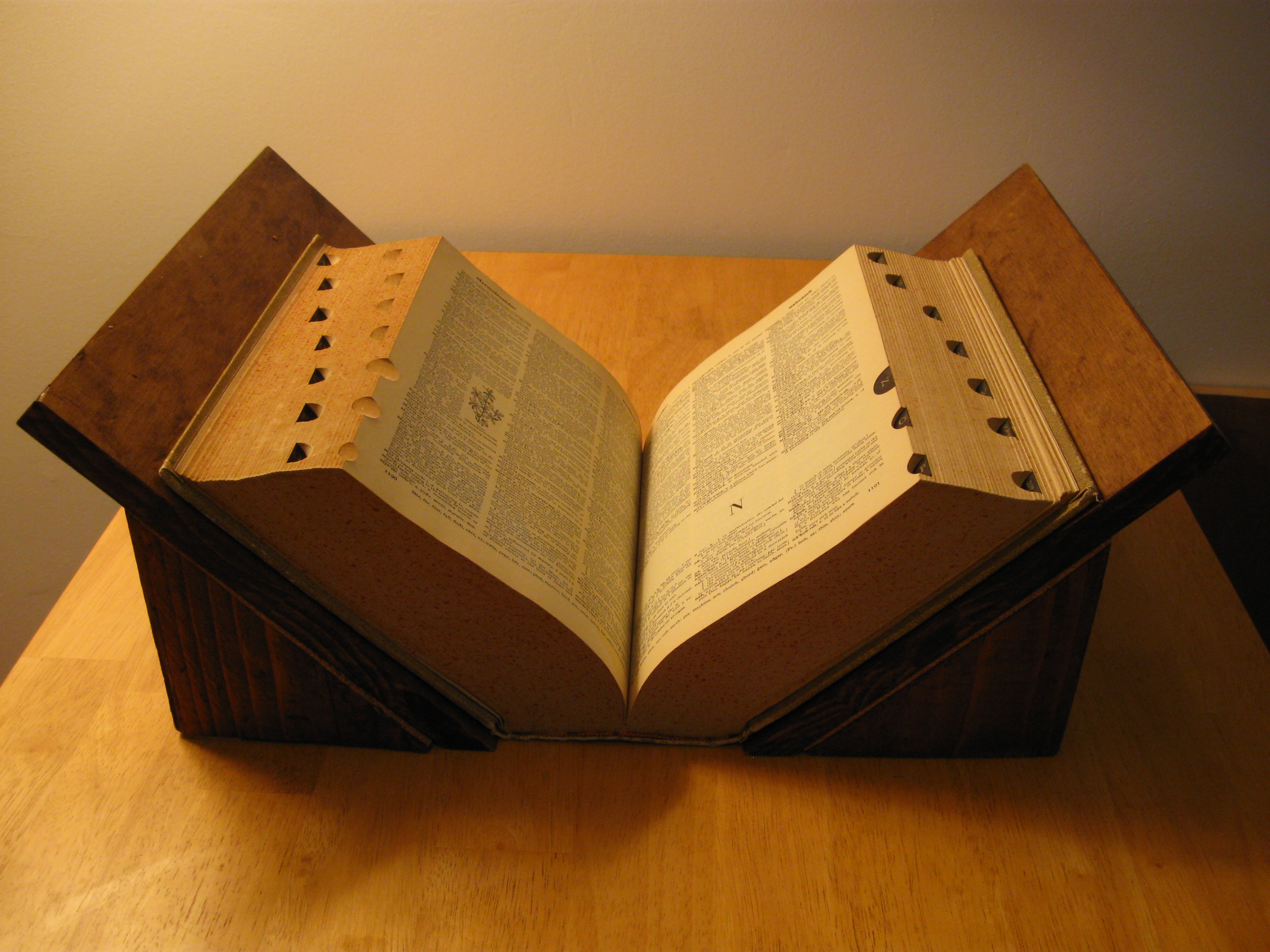
Lisa also discussed the importance of protecting the book from less obvious damage; for example, I should always wash my hands before handling the book, in order to protect it from oils and other materials that build up on skin. Furthermore, the book should be kept in an acid-free box when it isn’t being examined in order to protect it from damage caused by the sun and environment.
Digital Humanities
In addition to teaching me how to handle old, important books, Lisa introduced me to the field of Digital Humanities, and talked about how DH tools may be helpful for my research. As she explained during our meeting, Digital Humanities is an up-and-coming field which examines the ways in which technologies of our digital age can be used to study the humanities.
For my research, I need a program that allows me to compare punctuation between several editions of Troilus, noting the differences between each edition so that I then can examine how each difference changes the meaning of the text.
Lisa recommended that I try Voyant, which is a text-analysis tool created for use in the digital humanities. Voyant has several interesting features with which I have since experimented (for example, it provides the frequencies of different words within a text, and will create a word cloud, similar to Wordle), but is perhaps not the best tool with which to examine punctuation specifically. In a later blog, I will cover some of the other computer programs I have tried out during this process.
Thank you so much to Lisa for taking the time to help with my research!
